


- Author:
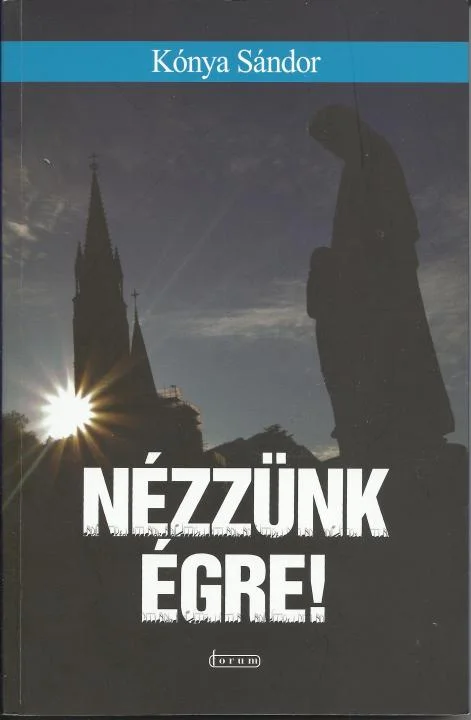
- Kónya Sándor
- Year and place of publication:
- 2014,Novi Sad
- Publisher:
- Forum Könyvkiadó Intézet
- Responsible publisher:
- ifj. Virág Gábor
- Series title:
- Létünk Könyvek
- ISBN:
- 978-86-323-0887-9
- Binding:
- soft
- Page count:
- 191 pages
Preface/Afterword
FOREWORD
Future-Creating Understanding of Tradition
The present questioning the otherness of the past – future creation and respect for tradition – collective memory – understanding the world – aesthetic experience – cultural identity: this associative and discursive sequence can form the motivational basis for the thought that created Sándor Kónya’s collection of studies and texts titled “Nézzünk égre!” (Let's Look Up to the Sky!); it awakened, sustained, and continues to sustain his research dedication to questioning the past and tradition.
It is well known that an attitude pointing to models and events of the past is always a questioning of present interest, which at the same time carries the characteristics of future creation. Understanding the past is a prerequisite for a functional way of life and a prospective future, just as the search for and understanding of tradition is the legitimizing force of national-cultural identity formation. According to Assmann's concepts, in addition to belonging to a linguistic collective, cultural self-definition is also an important element of identity.
Through the collection of Catholic folk hymns, Sándor Kónya turned towards a form of collective consciousness that contains the features of the otherness of the past, archaic cognitive and linguistic references, yet – like the existence of folk poetry – acts as a living form and tradition, a functioning culture; it is a fragment of the continuous past detectable in the present. During church liturgy and paraliturgical events, the community-forming and individuality-shaping system of customs, culture of behavior, collective memory, and world experience, and last but not least, a solid aesthetic value system, are passed on. In addition to the operation of respect for tradition and its transmission, oral dissemination, and variation formation, Kónya's collection provides insight into the processes of re-creation, continuation, transformation, and rewriting, the contemporary shaping of folk culture, and the emergence of new folk hymns.
The research into the songs of those returning home, the dream-dispelling, Christmas, Lourdes, and supplicatory songs, as well as the hymns of Saint Anne, Saint Francis, and Saint John, and the verses related to the “time of suffering” and the ceremony of the “unveiling” of the cross, along with the Kirje melodies – in addition to instrumental and vocal folk music – also involved interdisciplinary investigations and interpretations, necessitating a multicultural perspective. This volume’s representation of Vojvodina folk hymns is thus a repository of rich, multifaceted research: a breviary of cultural history, religious and material ethnography, folk poetry, cultural anthropology, folk psychology and aesthetics, and linguistics-dialectology. Besides offering insight into the world of songs connected to the events of the liturgical year, sacred folk consciousness, and religious customs, it also presents the formation and functioning of identity consciousness defined in a cultural sense. Through it, we gain insight into the cultic events and rituals of community life operating within sacred folk culture.
The natural starting point for Sándor Kónya's research was his immediate homeland, his birthplace (Čoka) and its surroundings, and after the publication of the volume of North Banat folk hymns, the temporal scope of his insight and the field of collection also expanded. The latter coordinates now encompass the entire territory of Vojvodina.
In addition to the song tradition preserved through oral transmission, the researcher's attention extends to and uncovers a large corpus of folk songs disseminated through local, private, and chapbook publications. Alongside historical contextual thinking, Sándor Kónya's investigations also have a theoretical orientation: this is most expressed in the formation of concepts and the creation of value coordinates.
*
The book Nézzünk égre!, Sándor Kónya's collection of studies and texts representing folk songs – hopefully – is the opening of a research and book series that, for the sake of the present and the future, questions the otherness of the past, uncovers traditions, and presents classical, value-creating tendencies, whose codes can be most fully interpreted in an interdisciplinary and multicultural environment.
BENCE Erika
***
AFTERWORD
In this volume, primarily with the intention of communication and popularization, I presented to the Reader a selection of songs from collections of recent years, but in some of the writings, I also tried to approach the secrets of variation formation. I did not want to avoid this important characteristic of living folklore, nor leave it unmentioned in the case of our secular folk songs: my writings related to variation, Our Soldier Songs and Actualization (1976), and The Relationship between Text and Melody in Our Folk Songs (1977), were published in the pages of Hungarológiai Közlemények. Some of the writings published here have also appeared in other journals. Mária szép rózsa – Lourdes-i énekeink (Mary, Beautiful Rose – Our Lourdes Songs) and Szent Ferencről zengjen szívünk égi dalt (Let Our Hearts Sing a Heavenly Song about Saint Francis) in Bácsország 2009/3 and 2009/4; Miért szép a hazaindulók éneke? (Why is the Song of Those Returning Home Beautiful?) in Híd 2011/6; and Szent Anna-énekek Csókán (Saint Anne Songs in Čoka) and Áloműző ének (Dream-Dispelling Song) in Létünk 2011/2 and 2012/1. The other writings were published for the first time in this volume.
*
I hereby thank all those whose efforts and goodwill assisted my work. Thanks to the singing informants who preserve our traditional songs and passed them on to the best of their knowledge. I gratefully remember the late Archpriest István Both, who supported my collections. I thank the Very Reverend József Mellár, Vicar General, the Very Reverend Ferenc Fazekas, Dean, the Very Reverend Ferenc Brasnyó, the Very Reverend Péter Szarvas, the Very Reverend Róbert Utcai, parish priests, Sister Mária Alix Csúszó Erzsébet, office manager Ilonka Faragó; Ilona Drenyovszki, Terézia Hatala, Larissza Kőműves, and Rozália Szeles, coordinators of the Christian Intellectual Circle, for their help in organizing the field collection.
I thank Erzsébet Nagy and Angéla Nagy for the Magyarcsernye data. Szöszill Kovács for the South Banat collections, and Jenő Lázár for photocopying the Torda manuscript cantor books. Thanks are due to the acquaintances and friends who took the photos and contributed to the appearance of this volume with their pictures.
The volume was compiled at the instigation of Erika Bence and Ferenc Németh. I thank them for their honorable invitation and their trust in my research work.
Flap Text
The research into the songs of those returning home, the dream-dispelling, Christmas, Lourdes, and supplicatory songs, as well as the hymns of Saint Anne, Saint Francis, and Saint John, and the verses related to the “time of suffering” and the ceremony of the “unveiling” of the cross, along with the Kirje melodies – in addition to instrumental and vocal folk music – also involved interdisciplinary investigations and interpretations, necessitating a multicultural perspective. This volume’s representation of Vojvodina folk hymns is thus a repository of rich, multifaceted research: a breviary of cultural history, religious and material ethnography, folk poetry, cultural anthropology, folk psychology and aesthetics, and linguistics-dialectology. Besides offering insight into the world of songs connected to the events of the liturgical year, sacred folk consciousness, and religious customs, it also presents the formation and functioning of identity consciousness defined in a cultural sense. Through it, we gain insight into the cultic events and rituals of community life operating within sacred folk culture.
BENCE Erika
Table of Contents
- Előszó – Jövőalkotó hagyományteremtés5
- Bevezető7
- Miért szép a hazaindulók éneke?9
- Áloműző ének15
- Öt seb – A recitációtól a négysoros stórfáig23
- A Kirje-dallam vajdasági változatai38
- Szent vigasság szívünket betöltse! – Karácsonyi énekek61
- Lourdes-i énekeink81
- Szent Anna-énekek Csókán103
- Szent Ferencről zengjen szívünk égi dalt120
- Szentjeinkhez szóló, oltalmat és közbenjárást kérő énekek 139
- Szent János áldása169
- Utószó183
- Irodalom185
- Énekesek189