



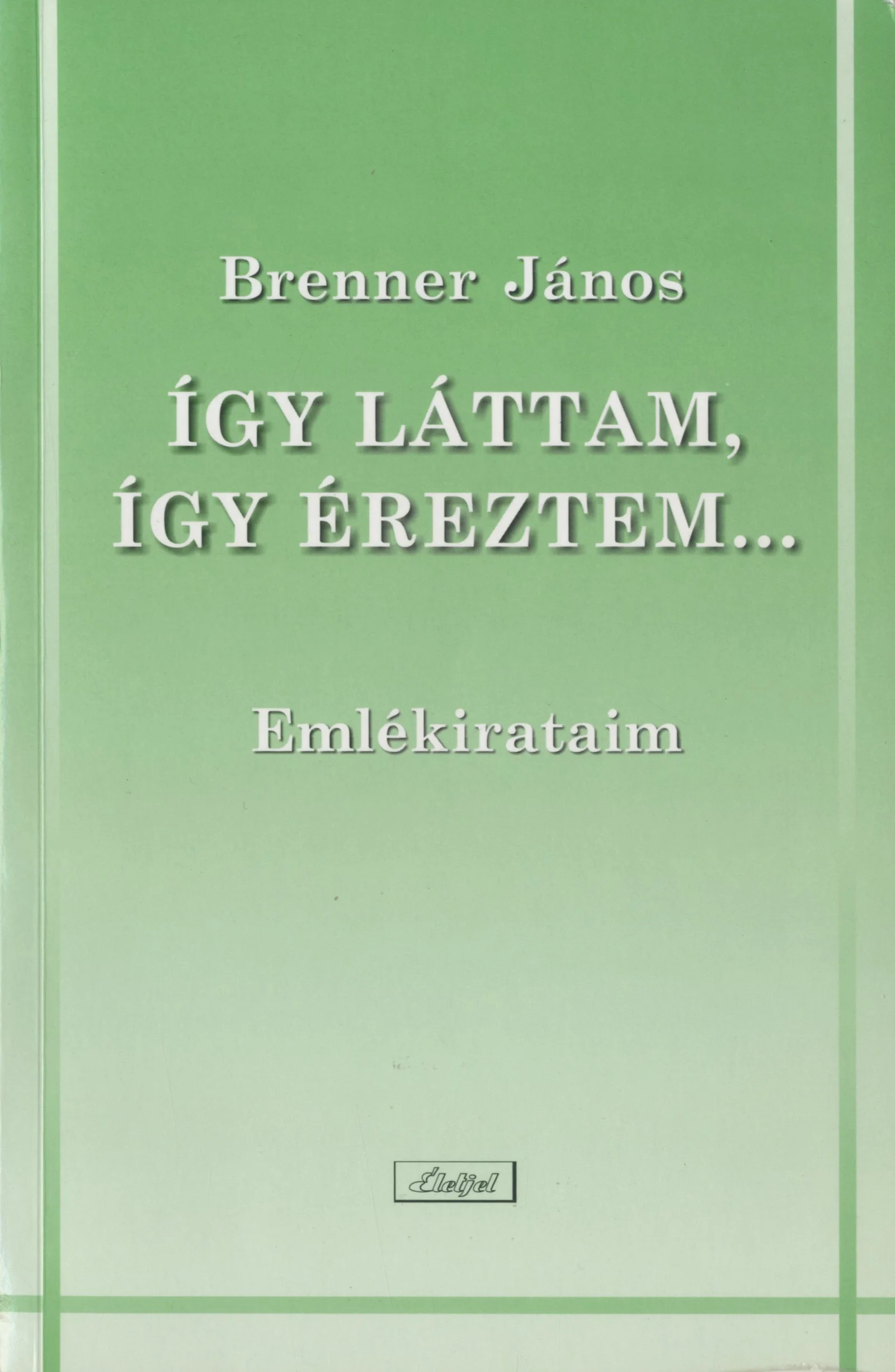
- Author:
- Brenner János
- Year and place of publication:
- 2003,Subotica
- Publisher:
- Szabadkai Szabadegyetem
- Responsible publisher:
- Perović, Blažo
- Series title:
- Életjel Könyvek
- ISBN:
- 86-82147-53-1
- Page count:
- 319 pages
- Art form:
- epic poetry
- Genre:
- Memoir
Flap Text
If Tibor Kolozsi had not written Pénteki találkozások (Friday Encounters) for the 25th anniversary of 7 NAP, and if Zoltán Kalapis had not published his book A Magyar Szó fél évszázada (Half a Century of Magyar Szó), we would have no written record of the Hungarian press in Vojvodina after World War II...
János Brenner's book Így láttam, így éreztem... (This is how I saw it, this is how I felt it...) is not a work of press history. An autobiography emerged from his workshop, yet it is so closely tied to Magyar Szó and 7 NAP that its press-historical relevance should not be underestimated. There can be little doubt about his expertise, as he has climbed every rung of the professional ladder. His method is not a mere enumeration. On the contrary! He strives to group his memories around major international events, and then related domestic events.
His book reveals that its author, driven by a desire to act, fights his battles as a perpetual motion machine in both his professional and private life against all obstacles, of which, as we know, there were many in the past 60-70 years...
The author moves a multitude of characters. But by no means in a vacuum, rather in the concentrated social environment so characteristic of the era. And although he tries not to paint them in black and white, he does not shy away from exaggerations if he feels that this allows him to provide a more expressive portrayal of them...
István CSORBA
János Brenner's book: Így láttam, így éreztem... (This is how I saw it, this is how I felt it...) is more than an autobiography. It is more because we not only learn about the events that happened to him, but he also characterizes and evaluates local and national events, politicians, and public figures.
Recalling his wartime childhood is a special experience. We here in Bačka know little about the wartime events in Banat. Only Mladen Markov's collection of short stories, Banatska vicinala (Banat Vicinal), deals with similar stories.
Personally, I was particularly interested in the part where he wrote about his student and soldier years. I finished high school and served in the army in the same years. I assert that he creates a very realistic picture of student life and military service at that time.
However, his journalistic career is already more than an autobiography. This profession brought him into contact with local and national politicians. He knew from the inside all the problems of the Hungarian press in Vojvodina, but also the social and economic phenomena and driving forces of the narrower environment and the country. The volume is a press and local history of the four decades after the war, especially concerning the material from his years in Subotica.
Mátyás HORVÁTH
Table of Contents
- Tudósítás Atlantiszból5
- Előhang7
- Egy kikindai polgárcsalád virágzása és széthullása9
- Egy kis történelem19
- Sárga vagy vörös veszedelem22
- Diligenter frekventáltam25
- Újságíró lesz belőlem30
- Egy évem a Magyar Szónál 33
- Szocialista hazámat szolgálom!38
- Ismét kirúgnak47
- Kóválygok ide-oda50
- Topolyán vagyok „riporter”55
- Ismét egy év Újvidéken62
- Szabadkára megyek és ott ragadok65
- SZABADKA66
- A szabadkai mellékletek felét se találom70
- Megnősülök és magam indulok külföldre75
- Szuezi válság, budapesti forradalom, zűrös idők81
- Visszatekintés és előrefutás89
- A 7 NAP98
- Csodálatos jó apának lenni113
- Családot alapítok120
- Igazi nyomdát szeretnénk!122
- Nekifutunk – kis híján a falnak124
- Törökországtól Afganisztánig131
- Mentem az Úristen háta mögé, özönvíz előtti időkbe149
- Rohanunk a reform felé156
- A reform162
- Fékezés – két alkotmány-módosítás között180
- Rohanok a kés alá196
- Nem hagytak meghalni205
- A 74-es alktománytól főszerkesztőségemig218
- 4 bőséges és 4 szűk esztendő226
- Rohanok az (idő előtti) nyugdíj felé243
- Nemcsak én éreztem magam jól256
- Szédelgek, mint a beteg léágy, majd – keresni kezdek260
- A Brenner nem hazudott269
- Nyakunkon a Milošvić éra274
- Összeomlik a 7 NAP279
- Tíz tudathasadásos év284
- A bombázások293
- Hogyan jutottunk idáig?298
- Vigyázó szemetek Magyarországra vessétek304
- Miért pofázhattam?311
- Forradalom volt313
- Epilógus315
- Tartalom317