
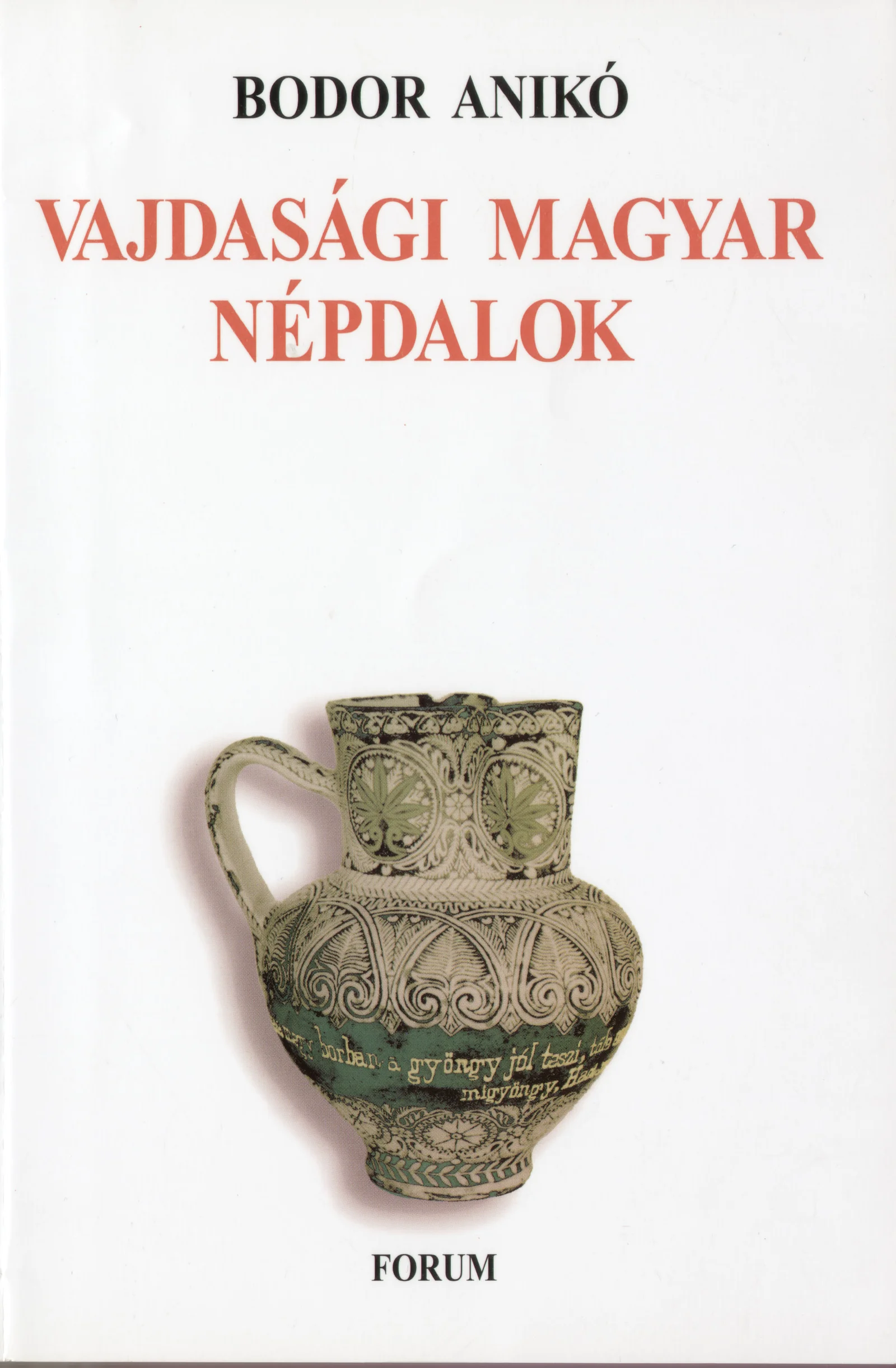
- Author:
- Bodor Anikó
- Year and place of publication:
- 1997,Novi Sad
- Publisher:
- Forum Könyvkiadó Intézet
- Responsible publisher:
- Bordás Győző
- ISBN:
- 86-323 -0462-3
- Binding:
- soft
- Page count:
- 349 pages
- Art form:
- lyric poetry
- Genre:
- Folk song collection
Preface/Afterword
FOREWORD
For a long time, we have felt the need for a publication that provides a general overview of the folk song heritage of Hungarians living in Vojvodina. This need arises partly from the desire to understand and introduce the values of our folk music tradition, and partly to provide source material and knowledge from our own narrower homeland for the folk music-loving and revival movements that have been fashionable for about a quarter of a century.
Based on our knowledge gained through previous collections and publications, the time has now come to provide an overview of the vocal folk music of the diverse Hungarian population living in Vojvodina, settled from various regions of the Hungarian linguistic area. The collected material is gratifyingly extensive, even if not all Hungarian-inhabited areas of Vojvodina are equally represented in terms of quantity. Therefore, we cannot strive for completeness, but we endeavor to present as many songs as possible to illustrate the richness, diversity, and organic unity of a healthy tradition. We plan to publish the material in four volumes: Lyrical Songs; Shepherd and Outlaw Songs, Prisoner Songs, and Ballads; Wedding and Love Songs, and Custom and Children's Songs.
Our current lifestyle is not conducive to the survival of communal culture. Many of the old musical and learning opportunities that sustained folk songs are now a thing of the past. But the need still lives within us. “For song is born out of necessity; it is a guarantee of the health of the human soul. It is not a performance or entertainment, but a fundamental need, bread for the soul,” wrote Bertalan Andrásfalvy in 1992.
Folk songs are no longer reproduced today, but like the works of great composers, they have remained with us as the heritage of our ancestors, an artwork born from the healthy balance of individual and community, and for us too, it is a tool against the storms of emotions. It is not merely a valued artistic asset, but also a utilitarian object that serves the joy of communal singing and belonging.
On the other hand, folk tradition preserves both valuable and worthless elements. Various fads equally destroy what is worthy and unworthy of preservation. Added to this is the detrimental effect of unfavorable circumstances on the life of healthy music folklore, which has been ongoing for a long time. Untainted tradition becomes worn in common use, degenerating with the prevalence of cheap market taste. Thus, not every folk song in common circulation is also an artistic creation.
The aim of our planned series is to publish as much as possible of the untainted folk music tradition of Hungarians in Vojvodina. Its primary goal is popularization, but it also strives to meet scientific demands. Our first volume contains 200 lyrical songs. We hope it will provide a pleasant surprise for young cultural educators, bring joy to mere enthusiasts, and make the eyes of villagers light up when they recognize the tunes of their grandparents. Our folk music heritage is an integral part of Hungarian folk music as a whole, and its values are worthy of public esteem. These values have been preserved for us by the people of the villages.
“Music is not the pastime of solitaries, but a spiritual resource that every civilized nation strives to make public property...” – wrote Zoltán Kodály in 1934.
Table of Contents
- Előszó5
- Bevezető7
- A kötet anyagának gyűjtői13
- A közreadás szempontjai14
- Betű- és zenei jelek20
- Katonadalok 1–74. sz.
- El kell menni katonának messzire 1–20. sz.22
- Rukkolnak a szép zentai legények 21–40. sz.50
- Várni, várni, várni, jaj, de nehéz várni 41–44 . sz.79
- Kaszárnya, kaszárnya 45–58. sz.83
- Kedves jó anyám, nem írok több levelet 59–69. sz.102
- Nyisd ki, anyám, zöldre festett kapudat 70–74. sz.119
- A hétköznapok dalai 75–125. sz.
- Búza, búza, de szép tábla búza 75–84. sz.129
- Jaj, de sokat arattam a nyáron 85–96. sz.143
- Ősz az idő, hideg vagyon 97–105. sz.160
- Béres vagyok, béres 106–109. sz.173
- De nehéz sorsa van a szegény summáslánynak 110–113. sz.178
- Elmegyek, elmegyek 114–120. sz.184
- Ha a hazádba megélhetsz 121–125. sz.194
- Szerelmi, tréfás és egyéb dalok 121–125. sz.
- Sűrű, sötét felhők vándorolnak az égen 126–143. sz.204
- Ugyan, rózsám, hová lettél 144–165. sz.231
- Kocsmárosné, hallja 166–173. sz.261
- Akármerről fúj a szél 174–191. sz.272
- Keresem a lovam 192–196. sz.305
- Volt énnékem édesanyám, de már nincs 197–200. sz.310
- Mutatók315
- Térképek315
- Rövidítések320
- Irodalom320
- Lemezek, kazetták322
- A dalok lelőhelyei322
- Zenei mutatók324
- Szótagszámmutató324
- Szorzárlatmutató326
- Táncmutató329
- A kezdő sorok betűrendes mutatója329
- A dalok forrásjegyzéke344