



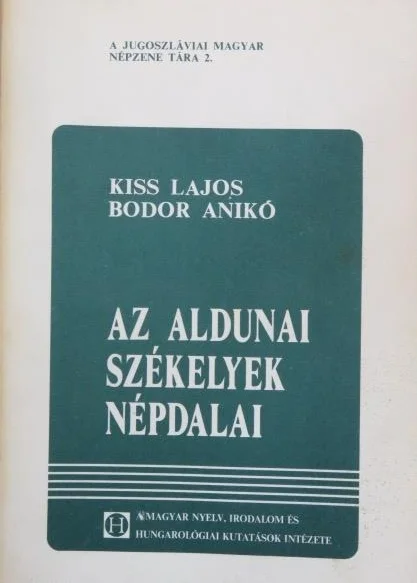
- Author:
- Kiss Lajos, Bodor Anikó
- Year and place of publication:
- 1984,Novi Sad
- Publisher:
- Magyar Nyelv, Irodalom és Hungarológiai Kutatások Intézete
- Series title:
- A jugoszláviai magyar népzene tára
- Binding:
- soft
- Page count:
- 588 pages
- Genre:
- Folk song collection
Preface/Afterword
In this volume, we publish the folk songs collected by Lajos Kiss from the Székely settlements in southern Banat that originated from Bukovina: Hertelendyfalva (Vojlovica), Székelykeve (Skorenovac), and Sándoregyháza (Ivanovo). This is the first publication of such a scale from an area that preserves the most archaic layer of the diverse folk music tradition of Hungarians in Yugoslavia.
Zoltán Kodály first drew attention to the valuable musical traditions of the Székelys who settled in Bukovina in 1914. In 1935, Péter Balla visited the Bukovina Székelys again. After World War II, Hungarian experts collected a vast amount of folklore material (folk music, folk tales, folk beliefs, folk dances, etc.) from the Bukovina Székelys who were resettled in Hungary.
No one dealt with the folk music of the Lower Danube Székely villages until the 1940s. It was then that Lajos Kiss, a folk music researcher from Zombor, began his collecting work among the Hungarians in Yugoslavia. He first visited Hertelendyfalva in 1940–1941, then, after a twenty-five-year break, in the 1960s (1966–1969). Approximately 70 songs from his collection have been published in various popular and scientific publications to date. Also in the late sixties (1968–1969), he visited the other two Székely villages, Székelykeve and Sándoregyháza, and collected there as well, though significantly less than in Hertelendyfalva.
In the 1950s, Ernő Király, head of the Hungarian folk music department of Radio Novi Sad, conducted a larger-scale collection among the local Hungarians, including the Lower Danube Székelys, on behalf of the Vojvodina Museum. At the same time, Olga Penavin, a professor at the Hungarian Department in Novi Sad, began her dialect and folklore research, continuously publishing about the southern Banat Székely settlements from the early seventies.
In 1966, Zoltán Újváry conducted research in Hertelendyfalva and Sándoregyháza. Part of his Hertelendy collection was published in 1968.
In the early seventies, Imre Bori's comprehensive overview of the folk poetry of Hungarians in Yugoslavia was published. Two Serbian-language articles from the early fifties about the Easter egg painting and folk customs of the people of Hertelendyfalva should also be mentioned. These appeared in the yearbook of the Vojvodina Museums (Rad vojvođanskih muzeja). The Lower Danube Székely folk song material collected by Lajos Kiss, especially that from Hertelendyfalva, is quantitatively the most significant to date. But it is not only in scope. Lajos Kiss's collecting expertise, keen observation skills, and thoroughness in recording numerous variants of melodies particularly valuable from a traditional perspective, his detailed transcriptions (from on-site recordings in the forties and machine recordings in the sixties), and not least the twenty-five-year period between the two collections, are all aspects that, in addition to the material's publication, enhance the scientific value of the collection. We present this remarkable work in its entirety to the interested reader.
Completeness, unfortunately, only refers to the material. We are unable to possess the personal connection Lajos Kiss had with his informants and collecting area, nor his extensive knowledge in the field of folk music.
We try to compensate for this deficiency by utilizing the collector's notes and the available source materials.
Table of Contents
- BEVEZETŐ
- 1. Rövid történeti áttekintés5
- 2. Az aldunai székelyek11
- 3. Dallamaik18
- 4. Tájékoztató a kötet összeállításáról22
- 5. Zenei jelek magyarázata28
- DALLAMREND
- I. Ütempár szerkezetű dalok: 1–19 sz. 33
- II. Strofikus szerkezetű dalok: 20–399 sz.53
- A – A kezdősor magasabb a zárósornál: 20–128 sz. 55
- B – A kezdő- és zárósor azonos: 129–253 sz.165
- Törzsréteg – B1: 129–178 sz.167
- B1 – kis ambitusú kezdősor: 129–153 sz.169
- B1 – nagy ambitusú kezdősor: 154–172 sz.188
- B1 – az első két sor azonos: 173–178 sz.202
- Átmeneti réteg – B2: 179–212 sz.209
- B2 – kis ambitusú kezdősor: 179–196 sz.211
- B2 – nagy ambitusú kezdősor: 197–205 sz.225
- B2 – az első két sor azonos: 206–212 sz.232
- Idegen réteg – B3: 213–253 sz.239
- B3 – kis ambitusú kezdősor: 213–236 sz.241
- B3 – nagy ambitusú kezdősor: 237–244 sz.256
- B3 – az első két sor azonos: 245–253 sz.262
- C – A kezdősor magasabb a zárósornál: 254–349 sz.271
- Törzsréteg – C1: 254–262 sz.273
- Átmeneti réteg – C2: 263–310 sz.283
- Idegen réteg – C3: 311–349 sz.331
- D – A kezdő- és zárósor hasonló: 350–369 sz.371
- Törzsréteg – D1: 350–357 sz.373
- Átmeneti réteg – D2: 358–364 sz. 381
- Idegen réteg – D3: 365–369389
- E – A kezdősor mélyebb a zárósornál: 370–399 sz.397
- Átmeneti réteg – E2: 370–378 sz.399
- Idegen réteg – E3: 365–369 sz.409
- Függelék: Székelykevei (Hadikfalvi) betelehemes429
- JEGYZETEK
- I. Ütempár szerkezetű dalok443
- II. Strofikus szerkezetű dalok446
- A osztály446
- B osztály448
- B1 – törzsréteg 490
- B2 – átmeneti réteg498
- B3 – idegen réteg503
- C osztály507
- C1 – törzsréteg507
- C2 – átmeneti réteg510
- C3 – idegen réteg516
- D osztály521
- D1 – törzsréteg521
- D2 – átmeneti réteg522
- D3 – idegen réteg523
- E osztály524
- E2 – átmeneti réteg524
- E3 – idegen réteg524
- RÖVIDÍTÉSEK
- IRODALOM
- MUTATÓK
- Zenei mutató sorvégző hangok szerint 541
- Zenei mutató szótagszám szerint546
- Dallammutató551
- Műfajmutató561
- Dalszövegek mutatója562
- A gyűjtött dalok jegyzéke568
- A dalosok betűrendes mutatója581
- TÁJSZAVAK