
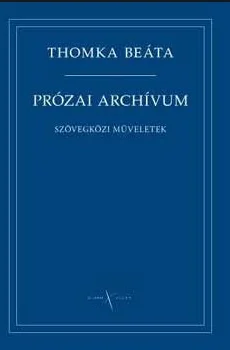
Prózai archívum
Content translated to English by AI
- Author:
- Thomka Beáta
- Year and place of publication:
- 2007,Budapest
- Publisher:
- Kijárat Könyvkiadó
- ISBN:
- 978-963-9529-53-3
- Binding:
- soft
- Page count:
- 168 pages
- Genre:
- Study
Preface/Afterword
Miklós Mészöly’s prose poetics can also be approached as a complex web of overlaps, appropriations, rewritings, quotations, motif migrations, excerpts, text fragments, and intercalations. Interruptions and insertions (intercalation) that do not cause a break both enliven the intertextual, inter-artistic, and inter-discursive expanse. The stylistic, narrative rhetorical, and poetic aspects of these operations deserve attention. Péter Nádas refers to appropriations that become organic to one’s own language: “There are no necessary and unavoidable constraints in his sentences, no foreign elements; he does not apply the mother tongue, but has created his own through nearly fifty years of work, and thus the seams are not visible; even the guest texts or hidden quotations are his own. Everything is built together, flavored, nothing detaches from anything.” (Nádas 1999)
My commentaries were prepared and are published concurrently with Mészöly’s posthumous book, Műhelynaplók (Workshop Diaries) (2007). The care of his manuscripts provided a unique perspective on his preliminary work, although it only extended to the handwritten material of his reading diaries and notes. The traces of his hand, the difficult-to-read notes, and insertions do not provide a direct passage to the finished and published works. Nevertheless, spelling out, deciphering, copying, and annotating carry a rich experience, one element of which is the visual ensemble of handwriting, fragmentation, graphic signs, and the appearance of the script.
The concepts of embedding and indentation perhaps playfully, but not coincidentally, evoke certain spatial relationships, as one of the inherent features of poetic procedures is a plastic, relief-like effect. As a distant parallel, they recall the aerial perspective evident in Roman reliefs, the intarsia-like effect of patches of light and shadow. The linear and planar narrative style is disrupted by appropriations and borrowings. It is peculiar that Mészöly’s stories constructed in this way, like reliefs, are capable of presenting multiple planes further removed from the reader or viewer, and compel the gaze to oscillate in time and/or space. As a literary parallel, I would refer to André Gide’s Journal entry, the “en abyme” procedure of escutcheons, which has become a characteristic category of contemporary narrative art and theory.
The main thrust of the writings in this volume is shaped by these insights. Attention is directed to questions concerning prose works and handwritten notebooks, and reading diaries. Some additional studies discuss theoretical aspects related to the works and arising in interpretations within a broader framework. More precisely, in addition to timely research directions, the exploration and surveying within the space and time of the oeuvre itself make it indispensable to discuss questions such as the relationship between author and narrator, fiction and biographical fiction, definitive and transitional forms, narrated and visual identity, or the poetics of cultural identity. The concluding chapter is a thesis-like summary of my presentations delivered at international conferences abroad.