



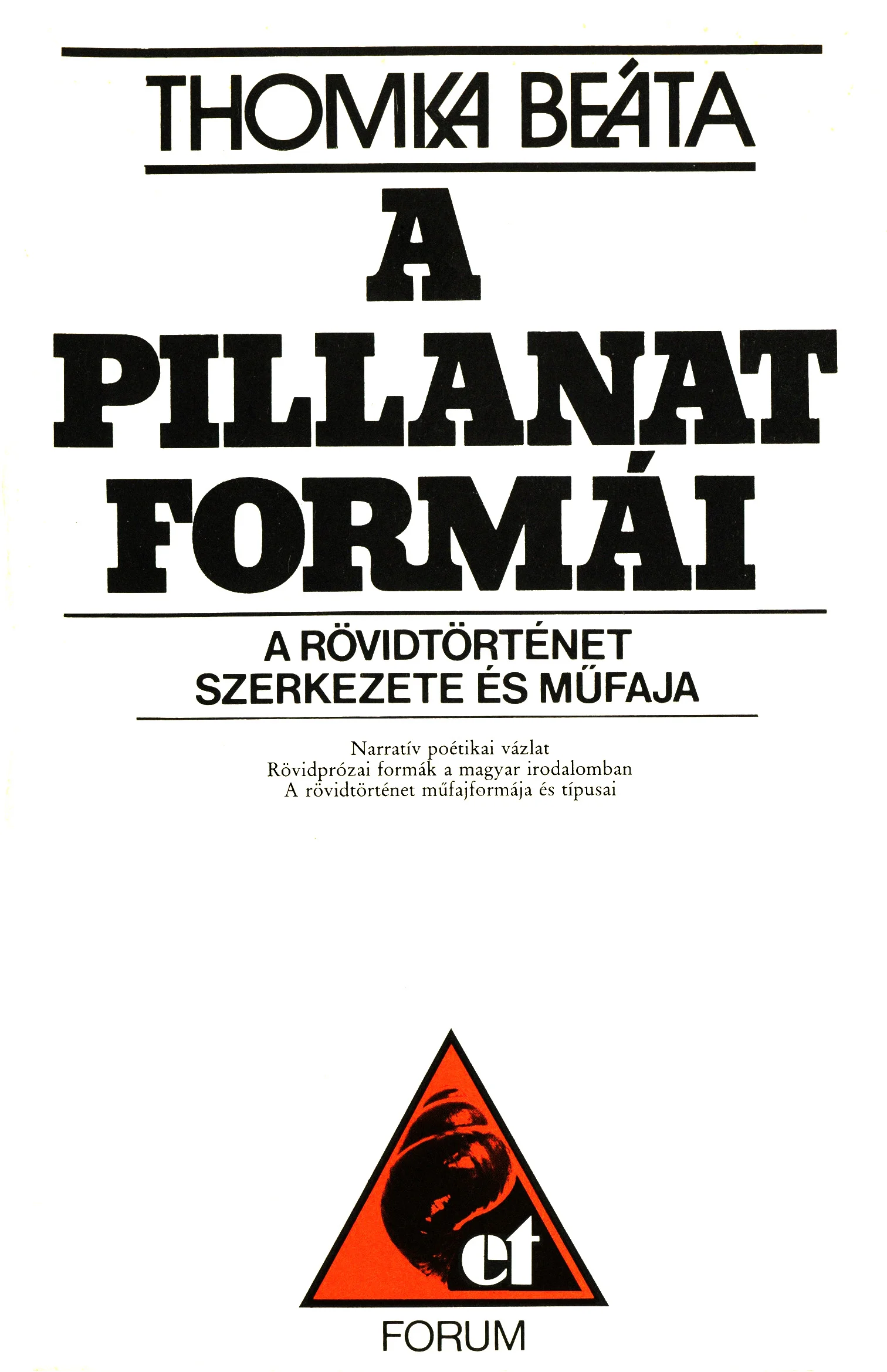
- Author:
- Thomka Beáta
- Year and place of publication:
- 1986,Novi Sad
- Publisher:
- Forum Könyvkiadó Intézet
- Responsible publisher:
- Bányai János
- ISBN:
- 86-323-0017-2
- Binding:
- soft
- Page count:
- 228 pages
- Genre:
- Study
Preface/Afterword
FOREWORD
Regarding Chekhov and Maupassant, masters of the short form, of the short story, Thomas Mann writes that for a long time he looked down upon their short prose, which did not require “heroic perseverance,” until he realized “how much the short and concise writing can gain in inner measure through the power of genius, what a – perhaps above all admirable – density it can absorb the entire fullness of life, can generally rise to epic rank, and even surpass the great, the monumental work in artistic effectiveness, which then inevitably tires or sinks into respectable boredom.” I turn to Thomas Mann, the master of the grand epic, for affirmation in the introductory note of this volume, which undertakes the examination of the forms of the moment, the genres of short prose, and among them, above all, the short story. Why is affirmation needed? Perhaps to dispel the reservations that, in line with Thomas Mann’s early views, have almost until now influenced the critical approach to short prose. This approach may seem peculiar and increasingly unjustified, because in 20th-century Hungarian prose and modern world literature, short prose forms have gained citizenship and conquered new ground, and furthermore, the role and significance of prose itself within culture seem to have changed.
This process is reflected in the increased literary-scientific and critical interest in prose poetics. Criticism seeks to present prose-creating procedures, structures, and genres in a new light, but predominantly focuses on the novel and its transformations. One of the generalizable experiences is that the novel has gradually been filled with non-epic elements and cannot be explored based on the traditional conceptual parallel of epic-totality. From this point, moving towards shorter prose forms than the novel, the claim to completeness of individual genres further decreases, divides, and transforms. Yet, there is no talk of its disappearance, not even in the case of fragments of a few lines that are volumetrically close to lyrical poetry. The most exciting questions are precisely how narrative texts of a few lines can condense complex contents, how they became suitable for capturing the experience of existence in a glance instead of an encompassing epic view, concentrating the story in the situation, while limiting the temporal extension to the moment. The distinction between the story and its narration within the artwork is now unavoidable, as the latter is not only the “arena” for communicating the sequence of events, but also the scene of allusions, indications, pointers, cuts, omissions, with the spread of metaphor and suggestive narration, and the deepening and layering that occurs simultaneously with the assertion of reduction: the triumph of compression. It is possible that all these phenomena can be explained by the critical sadness of the artwork, which Thomas Mann spoke about in his quoted writing. Behind the omission and compression that create the genre form of the short story, there are not only the newly recognized or newly conscious possibilities of narrative prose, but also a series of doubts. These doubts cannot be avoided even in the attempt to orient oneself in the world of constantly changing, transforming, almost intangible short forms. Especially if this world is not to be systematized in terms of some norms, but to be understood and described with the existing tools.
Table of Contents
- Előszó
- I.
- Narratív poétikai vázlat11
- 1. Az elbeszélőszerkezet11
- 2. Formálódó elvek és narratív retorikai műveletek21
- 3. A dinamikus műfajfogalom32
- II.
- Rövidprózai formák a magyar irodalomban41
- III.
- Lovik rövidprózájának elbeszélésszerkezeti és műfaji kérdései57
- 1. Egyszerű formák és fantasztikus elbeszélés58
- 2. A keretelbeszélés változatai65
- 3. A drámai novellától a történetszerűség funkcióvesztéséig 71
- 4. Az anekdotikus történetmag és az egyeseményű történet 76
- 5. Távolodás a klasszikus novellaformától81
- IV.
- A szimbolista elbeszélőszerkezet és a Kosztolányi-rövidtörténet formajegyei 89
- 1. Kosztolányi korai elbeszélő formái89
- 2. A redukált létélmény formája109
- 3. A realista szimbolizmus és a groteszk realizmus formatendenciái 132
- V.
- A tömörség poétikája – az „egyperces” rövidtörténet retorikája141
- 1. A dialógusos rövidtörténet146
- 2. Parabola-paródiák152
- 3. Poétizált egyszerű formák164
- 4. A rövidtörténet mint strukturális paródia és a groteszk miniatűr formacélja 172
- VI.
- A rövidtörténet műfajformája és típusai183
- Jegyzetek199
- Kiadások208
- Irodalomjegyzék209