



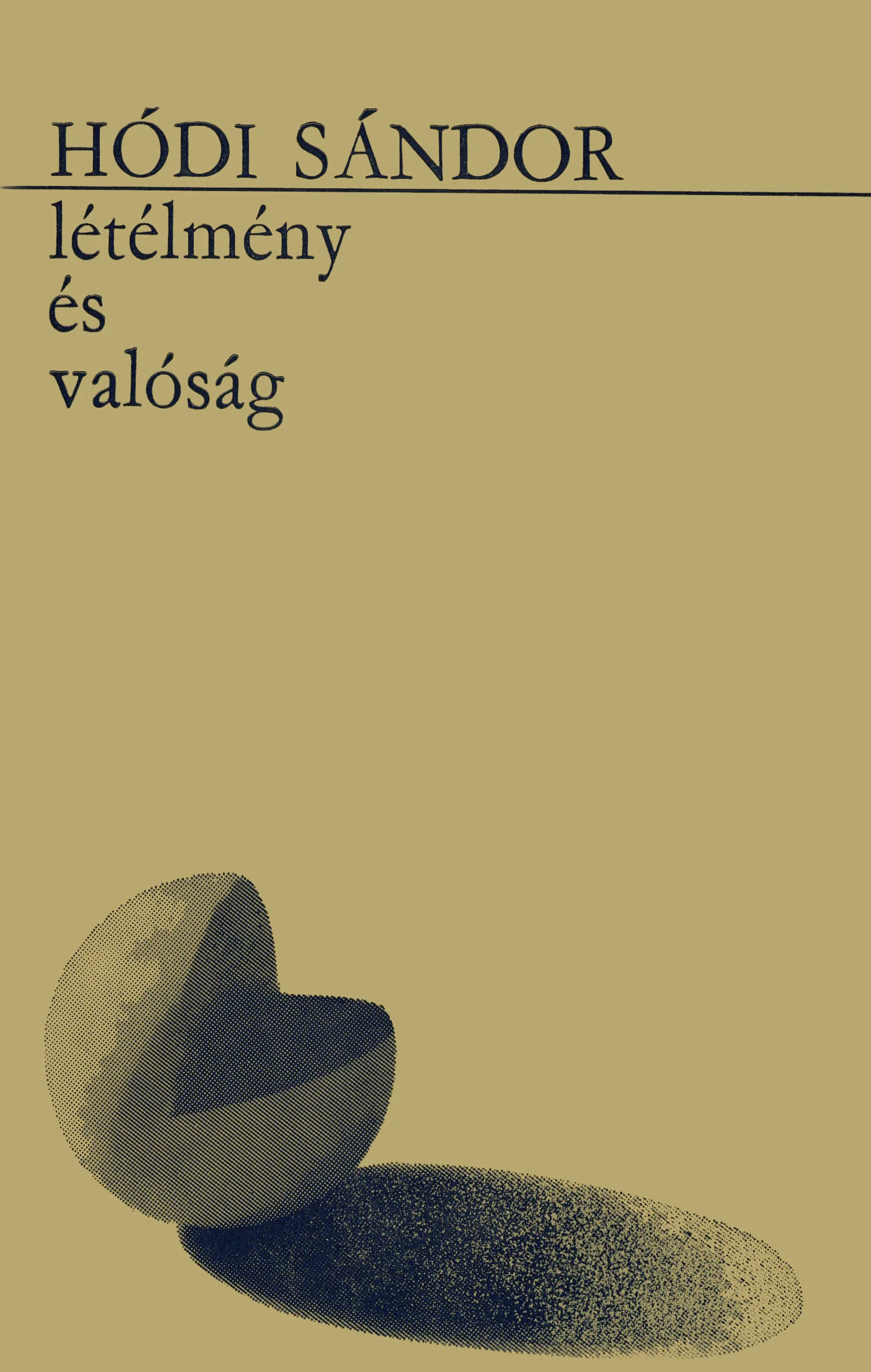
- Author:
- Sándor Hódi
- Year and place of publication:
- 1978,Novi Sad
- Publisher:
- Forum Könyvkiadó Intézet
- Series title:
- Gemma Könyvek
- Binding:
- soft
- Page count:
- 100 pages
Preface/Afterword
AFTERWORD
In the GEMMA series, within the framework of which this collection of studies is published, the first volumes of young, emerging poets have been published so far. The studies published here are also the products of a beginning, bearing the characteristic difficulties of searching for a path, but – being studies – they are also characterized by a number of specific problems.It is known that the relationship between content and form in literary works is different from that in scientific treatises. While, for example, this relationship is unbreakable in poetry, the intellectual material of a study can be embedded in a new form several times. Sometimes it is enough to reread and rethink what we have previously put on paper as a convincing reasoning, so that, in possession of new ideas that have arisen unexpectedly, concepts that seem more apt, and associations that feel more coherent, we find the expression of our thoughts in a given form too narrow, one-sided, and convulsive. Not to mention the „form-destroying” effect of further pondering, new knowledge, and reading experiences. This volume, in its current form, was ready for publication as early as May 1976. And if two years is perhaps not yet considered a critical time in terms of the „expiration” of the intellectual validity of scientific reasonings and philosophical reflections, at the beginning of a career, that is, in the notoriously impatient period of the first intellectual „assault” on reality, this is still a significant time. It is significant also because, alongside the „oversized” demands and aspirations that may naturally arise at such times, there is also an increased dissatisfaction with what has been achieved. This is so much the case that what one day is a desired goal as a tormenting intellectual effort, the impatient self-correction would destroy the next day with its realization. However, the solution cannot be to continuously rework, to constantly rewrite what we have already put on paper. For two reasons. Firstly, because if we have ultimately failed to arrange our intellectual efforts into a satisfactory form, if we have not – or not quite – said what we actually wanted to, this dissatisfaction will seek a solution for itself in new works anyway. Secondly, it is not advisable to reach back from a later period of our lives to prune, to „cosmetize” our earlier thoughts, because we would actually be concealing our mistakes with this modest correction, and this would be unfair both to ourselves and to others – our readers.Most of the studies that form the basis of this volume have already been published in various journals. Primarily, however, it was Híd that served as a kind of „workshop” for the author. It is perhaps not an exaggeration to talk about a workshop, if we consider that the nature of this forum – both the sophistication of the editing and the composition of the readership – largely determined the way and manner in which the psychological-philosophical issues under analysis were discussed. It was not a matter of unilaterally satisfying definite expectations, but, on the contrary, a good example of the fruitful reciprocity of cooperation. As the editorial concept of Híd approached the ever-wider, more multifaceted social science grasp of the personal and social problems of man with its openness, so the author could also realize his goal of approaching a wider readership instead of the „closed-door” discussion of specialized scientific-philosophical problems. Today – from a distance of two years – the author can acknowledge with due criticism how and in what he should have gone further in this direction, for example, although he initially tried to break with the fashionable affectations of specialized scientific text rigidity, as well as the ever-haunting dangers of the obscure depths of abstract philosophical speculations, he still could not sufficiently assert the subjective tone, directness, and informality of the „essayistic” style he desired and considered desirable. Namely, because – the „dissertation rigidity” of the still recent school years, or the generally experienced „convulsiveness” of social science expository prose, as a reading experience, reflexively rebounds in these first independent thought experiments. At the same time, we must also know that the studies published here, even with their previous „concessions”, have „violated” the strict rigidity requirements of modern scientific treatises, and are no longer „correct” enough in the face of the criteria of maximized depersonalization. And thus, the „genre” itself becomes problematic. This necessarily occurs whenever, instead of a rigid, template-bound (difficult to understand, and even less enjoyable) „scientific” expression of thought, we approach a more subjective and informal „literary” form of expression.Of course, there is more to it than just a stylistic question. Since the form of expression is nothing more than a scheme of thought, the sanctified template stubbornly resists the validation of thoughts that can be grasped in a new form. Thus, the schemes of specialized scientific expression of thought, fixed as requirements and criteria, also stand in opposition to the possibility of a scientifically demanding exposition of certain realities. And the author came into conflict with this very scheme of thought. The search for a new form of expression – another question, of course, with what success – is only a necessary consequence of this. All this is naturally deeply related to the author's choice of topic, the specific direction of his interest, and the general practice that, in scientific research, researchers discreetly deflect the discussion of subjective issues of human life from themselves due to some false consciousness, scheme of thought. Which is undoubtedly a strange practice, if we consider that man, in his concreteness, exists only as a person, as only a subjective aspect of social-material relations, and that therefore – in contrast to the „immanent” goals and perspective of his independent science – every peculiarity of his social existence gains direct meaning and significance only in the concrete form of the subjective personal relationship.How is it possible, however, that man in his personal being, that is, in the concrete, personal aspects of his life, has become dispossessed and neglected both in the practice of research and in the scientific form of knowledge? The complex system of interrelationships of the reality of social-human relations, or rather a part of this system of relations – with the fragmentation of specialization – is analyzed by separate branches of science. However, man does not experience this complex system of social-material conditions of existence in a fragmented way, but as a unified whole of his personal life. For him, the essence of that unity is the most important – since this is his life, which the various branches of science break down into parts as specific aspects of our social-human relations, and thus eliminate. In this collection of studies, however, the author – both in his questions and in his choice of topics – places precisely this whole of social reality, experienced in lived personal experience reflections, at the center of his examination: he seeks the unity of the world manifested in personal existence – in the experiential content of life – which has been parceled out by the scientific „division of labor” and disintegrated in partial analyses. Experience – for man – is the evidence of existence. This would be the axiomatic condensation of the essence of the author's basic position. Approaching the question from another angle: the author – both with his current initial and hopefully later – examinations would like to contribute to the theoretical clarification of how and in what way the peculiarities of our social-human relations are manifested in the subjective experiential reflections of our personal life, that in the persistence of a feeling of life and in its personality-degrading, life-withering effect as a depressing mood, what contradictions of man's historical-social existence are currently revealed and gain tragic formulation... These, and other similar questions, are what the analysis of the experience of existence is called upon to reveal. But even this intention alone – regardless of its intellectual realization, the level of its intellectual execution – is a capital sin for social science thinking nurtured in the positivist traditions. Today there are still many who view this peculiar „scientific discipline” with no small concern and suspicion, not hiding that they see in it a hotbed of irrationalism, some new form of metaphysics. Admittedly, due to the twists and turns of history, Marxist theoretical works have not rushed to dispel these doubts either. On the contrary, under the influence of the personality cult and dogmatism, a real scientific vacuum was created in this area. The unsettling-stimulating effect of this conspicuous theoretical void is now increasingly felt. The fruitful differentiation of the Marxist social sciences has begun, „green light” has been given to the branches of science that have been forced into „illegality” for decades, and in general the way is open to the analysis and interpretation of the macro- and micro-changes of social reality. But „life”, the personally lived existence, the sociality represented in concrete experiential reflections, the subjective manifestations of the characteristics of our general co-existence relations, still live in many people's minds as a problematic area with a dubious ideological background. It is difficult to confront prejudices, intellectual biases. It is only worth arguing with works, but their maturation cannot be hastened with impatience, just as skepticism cannot delay their maturation.Of course, every form of human thinking carries within it the possibility of error. This is especially true for the search for new paths, which understandably wants to realize its possibilities much faster, wants to see its possibilities proven with much greater greed, than scientific research that can already boast of its merits, but has in fact already „run out” of its possibilities. In itself, however, simply the fact that we make the real totality of our personal-social relations, which come together in our experiences, the direction indicator of our interest, does not increase the danger that our line of thought will be drowned in irrationalism any more than the alienation from life associated with the specialized scientific parceling of our social-human relations carries this danger within it. For just as the explanation of existence grasped in our experiences carries within it the possibility of unified but superficial attempts at solutions, so too the specialized scientific narrowing of the subject, which clings to the „exactness” of objectifications instead of the „relativity” of life – to the objectified, „dead” form of the living face of life – can, without a proper point of reference, exaggerate the significance of the isolated moments of reality it examines. The objectivation basis of sociality, and the psychic manifestation of these human relations objectified in material and spiritual form in the concrete subject, are equally organic parts of human existence. It would therefore be just as much a mistake to examine the various objectivation forms of social-human relations exclusively in their abstract, objectified existence, that is, to depsychologize human existence, as it would be foolish to explain the peculiarities of our co-existence relations exclusively with some internal peculiarities of the human psyche – with the idealist conception of the soul. The material and spiritual relations fixed in the various social objectivations, and the dynamic psychic forms of the organization of these relations into personal experience, are in reality inseparable from each other. These two forms of manifestation are in fact only different expressions of the same existential content. We would eliminate the continuity, the dialectical transformation of the form changes of existence if we were to disrupt this unity in an ontic sense, if we were to give any side of this unity an elevated or exclusive role at the expense of the other. Thus – based on what has been said above – there is no subjective experience representation in us that does not somehow have a real social content, which is therefore not a consequence of the complex organization of our social-human relations. Naturally, it was not the aim of this modest collection of studies to provide evidence and validation for all this. A more nuanced discussion and more detailed explanation of this complex issue awaits later works. With his current work, the author already considers his goal achieved if he has succeeded in arousing the interested curiosity of the reader for this new research area.
Flap Text
DR. SÁNDOR HÓDI was born in 1943 in Kisoroszi, Banat. He graduated from the gymnasium in Zrenjanin, then for a few semesters he was a student at the Faculty of Arts of the University of Novi Sad. He continued his university studies in Budapest at the Department of Psychology of the Faculty of Arts of the Eötvös Loránd University, where he obtained a degree in clinical psychology. For a while, he conducted scientific research in Budapest with a scholarship from the VSZAT Executive Council. In the autumn of 1974, he defended his doctoral dissertation on the topic of suicide at the Eötvös Loránd University. His doctorate was confirmed by the University of Zagreb in 1975.Since 1975, he has been a psychologist at the Potisje machine tool factory in Ada. His studies have appeared in domestic and Hungarian journals – Híd, Létünk, Oktatás és Nevelés, Magyar Pszichológiai Szemle, Valóság – and in the Kilátó of Magyar Szó.
Table of Contents
- Bevezetés5
- Létélmény és fogalmi ábrázolás9
- Élmény és tudatforma14
- Életérzés és történelem19
- Kozmikus magányosság25
- A halálfélelem kompenzációja32
- Émény és személyeeség-konfliktus41
- Hangulatszabályozás: narkotikumok-pszichofarmakonok47
- Irracionális-e a szerelem51
- Élmény és alkotás58
- Becsvágy és önbecslés64
- Gondolatok az élet értelme nélküli polémiáról77
- Utószó85