



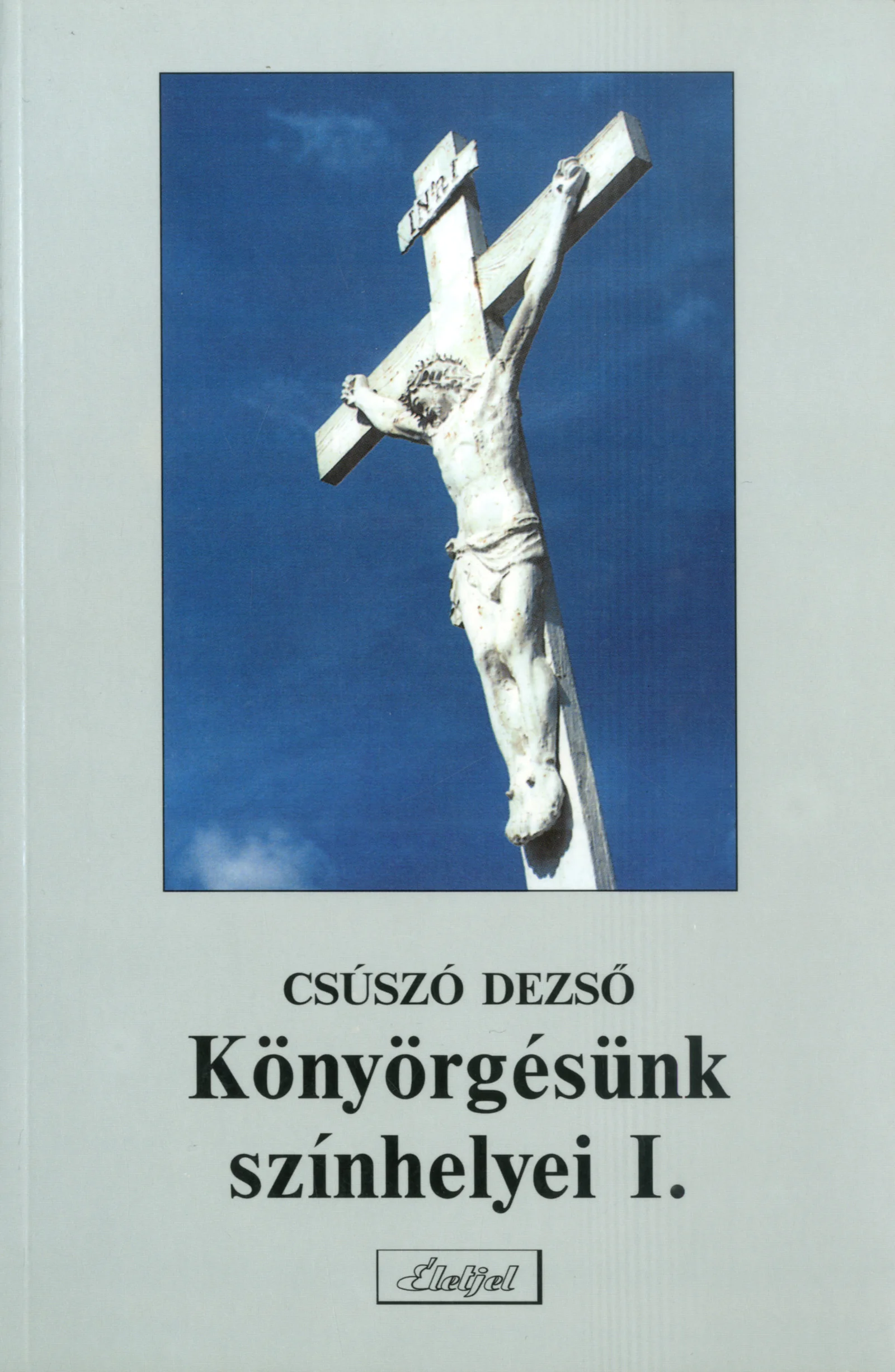
- Author:
- Csúszó Dezső
- Year and place of publication:
- 2003,Subotica
- Publisher:
- Szabadkai Szabadegyetem
- Responsible publisher:
- Perović, Blažo
- Series title:
- Életjel Könyvek
- ISBN:
- 86-82147-52-1
- Page count:
- 199 pages
- Genre:
- Monograph
- Subject terms:
- SuboticaLocal historyhistoryCrossesPublic crosses
Preface/Afterword
FOREWORD
Over the past centuries, our ancestors established hundreds of objects as places of – sometimes loud, sometimes silent – supplication, where prayers and entreaties were addressed to Jesus, Jehovah, Allah in Hungarian, Croatian, Bunjevac, Serbian, Jewish, German, Turkish, and who knows what other languages.
The diverse mixture of our cemeteries – in time and space – is a place where similar sorrows intermingle.
It would be a matter of respect for all these, and a work filling a gap, to compile a list of the sacred objects found in the city and its surroundings, as well as to photograph and video document the existing ones, and to search for traces of those that have disappeared.
Many have written about the city's churches, cemeteries, sacred sculptures, and chapels – articles, treatises, books – but public crosses are truly the "stepchildren" of specialized literature. Apart from a few incomplete listings – Gábor Tormásy, István Iványi, Antal Mojzes – there is no significant professional and literary treatment of them in Hungarian, nor are we abundant in Croatian and Serbian works. The publications of M. Šemudvarac and S. Rajšić are more attempts at inventorying than thorough analyses.
The number of public crosses erected in the region – from the Ottoman occupation to the present day – is estimated to be several hundred. Approximately 120 have been erected in the current area of the city. Beyond their role in the spiritual life of our peoples, their naming and inscription are of particular historical and national significance. These texts carved in stone convey much: national and denominational affiliation, material prosperity, faith in the future, world-weariness, but perhaps most importantly, they impose upon posterity – upon us – the sweet-bitter burden of remaining here.
Over the centuries, these elements of the sacred space have often become symbolic victims of various national and religious conflicts, but thanks to the tolerance of those living (remaining) here, subsequent rescue and renovation have often taken place. However, it was also up to us that much of the original forms disappeared – we simply allowed those deteriorating in decay, the victims of the cross-destroying times following the world wars, or modern vandalism, to be lost due to simple convenience. Despite all this, numerous Hungarian, Croatian, Serbian, and German inscriptions still adorn the public crosses of Subotica.
In the multi-denominational city, in the spirit of their ecclesiastical regulations – only Roman Catholics (hereinafter Catholics) and adherents of the Greek Orthodox Serbian Church (hereinafter Orthodox) erected public crosses. However, there are some objects where denominational boundaries blur. There is no doubt about the multi-ethnic and multi-confessional nature of the public cross erected at parcel 44 of the Senta cemetery in the past decade.
As a result of the change of country in the 20th century, the area of the city's outskirts changed, but the city itself and its immediate periphery remained unified, so the research difficulties arising in this field are negligible. Linguistic difficulties are only present in that, in addition to a smaller number of German and Latin documents, the author provides his own translation of official Serbian correspondence after 1918, relying on his language skills.
One of the essential aspects of my work is to map the locations of existing urban and peripheral public crosses, to photo-document the objects and inscriptions, and to publish the researched biographical data of those who erected them.
By presenting place names (streets, roads, squares, city districts) and personal names in their contemporary forms, and by verbatim copying the original petitions and minutes, I have tried to recreate the atmosphere of the time of the cross erection, as well as the charm of certain segments of social and spiritual life.
The Roman numeral in the title suggests the necessity of a continuation, which is not only planned but will also be realized within a foreseeable future.
I tried to emphasize the role of secular authorities and the bourgeoisie in the sacralization of space, therefore – with a few exceptions – I relied exclusively on the material of the secular archive. Special thanks to the staff of the Historical Archives of Subotica (hereinafter HAS) for their help in finding scattered material stored in various places. In the research of recent years, I have enjoyed the encouragement and unsolicited help of many individuals with different professional profiles. Thanks to the staff of the Institute for the Protection of Monuments (Valéria Beszédes, Géza Vas, and Gordana Vujnović Prčić), ethnographers István Nagy and Rozália Raj, the pastors of the parishes, and Lajos Hovány, Master of the Faculty of Civil Engineering in Subotica, for their selfless help.
The photographs, with a few exceptions, were taken by the author at the ZOOM PHOTO salon in Subotica. Thanks to the owners for their financial and professional assistance.
Finally, most gratitude goes to my family members, who for several years endured the minor and major inconveniences associated with the research.
Subotica, 2002
the author
Table of Contents
- Előszó5
- Bevezető7
- Szabadkai közkeresztek10
- Az egykori városárkon belüli közkeresztek25
- Templomok előtti keresztek25
- A kálváriákon felállított keresztek53
- Köztéri keresztek57
- A sándori közkeresztek92
- A szentkúti keresztek109
- A peremtérség közkeresztjei115
- Temetői közkeresztek163
- Bajai temető166
- Rókusi (Kéri) temető179
- Szentgyörgyi (Zentai) temető185
- Sándori temető193
- Forrásmunkák196
- Keresztmutató197
- Tartalom199