



Barbaricvm
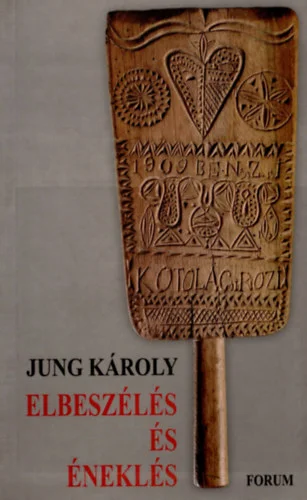
Elbeszélés és éneklés
Content translated to English by AI
- Author:
- Jung Károly
- Year and place of publication:
- 2004,Novi Sad
- Publisher:
- Forum Könyvkiadó Intézet
- ISBN:
- 86-323-0602-2
- Binding:
- soft
- Page count:
- 223 pages
- Genre:
- Study
This book, the sixth volume of my folkloristic studies, contains eleven papers; the majority of their topics are related to Hungarian textual folklore, while some papers discuss South Slavic textual folklore with Hungarian connections. All studies published here are a selection from papers written in the last few years, thus providing insight into my most recent research and analyses. A larger group of these investigations relates to questions of folk prose epics, and a smaller part to lyrical folk poetry, as well as epic art and popular poetry.
The first six studies deal with little- or unexamined questions of Hungarian (and South Slavic) oral legendary tradition: in the first, I review the examination of Hungarian and South Slavic folk tradition concerning dualistic world creation and its recently emerged epics; in the second, the legendary tradition of the forced killing of the elderly (gerontocide) is examined for the first time, including its three hitherto known Hungarian epics and their international connections, one of the texts having been previously unknown in Hungarian folklore studies; in the third, I discuss one group of Hungarian variants of the Ibycus Cranes prose epic text type ("ballangós variants") in light of new South Hungarian and South Slavic phytonymic data, as well as a hitherto unknown Serbian variant; the fourth study summarizes for the first time the legendary tradition concerning the crooked cross of the Hungarian Holy Crown and related public opinion data; in the fifth paper, based on two South Slavic folk epics, I offer insight into new research on the international connections of the Matthias tradition (the two texts were previously unknown in Hungarian research); the sixth study is the first comprehensive Hungarian overview of the Serbian legendary tradition related to Kossuth and Kossuthné's escape after the War of Independence; the seventh text can actually be considered a transition towards the research of lyrical folk poetry: with textual examples of the folk interpretation of the speech (voice) of bells, it provides an example of the possibility of a comparative study of a recently emerging folkloristic research area. The South Hungarian, Serbian, and German text variants cited in the paper, as well as forgotten or previously unnoticed Hungarian variants, may encourage further promising research into the topic.
The second series of studies touches upon some aspects of lyrical folk, art, and popular poetry: the first study, based on a rich collection of historical folk poetry examples, analyzes the symbolic function of the (small) garden and tulip in Hungarian folk lyric poetry, as well as in some ballad texts and play songs; in the second study, while investigating the meaning of a passage in the Zrínyiász, the functioning sign system of Hungarian folk poetry again offers a possible solution; the third analysis is related to Miklós Zrínyi, the hero of Szigetvár: it discusses his appearances as an epic hero in South Slavic lyrical epics, and at the same time provides an analysis and the first complete Hungarian translation of a Croatian historical song (recorded in the 19th century) from Western Hungary, hitherto unknown to Hungarian research; the concluding study discusses a Croatian epic song from Western Hungary, also unknown to Hungarian research (remained in manuscript), whose subject is the captivity and escape of Ferenc Rákóczi II. The study is followed by the first complete Hungarian translation of the song.
Information about the writing, possible conference presentation, and publication of the studies is provided in the relevant chapter of the volume. In the same chapter, I also provide new data related to the topic that has come to my attention or can in some way enrich our understanding of the problem. These additions and supplements also include further data that are considered novel in Hungarian research: new or unknown variants, supplementary connections, further literature. The reader can therefore gain a comprehensive picture of the questions examined only by studying the texts of the studies and the additions and supplements together.