



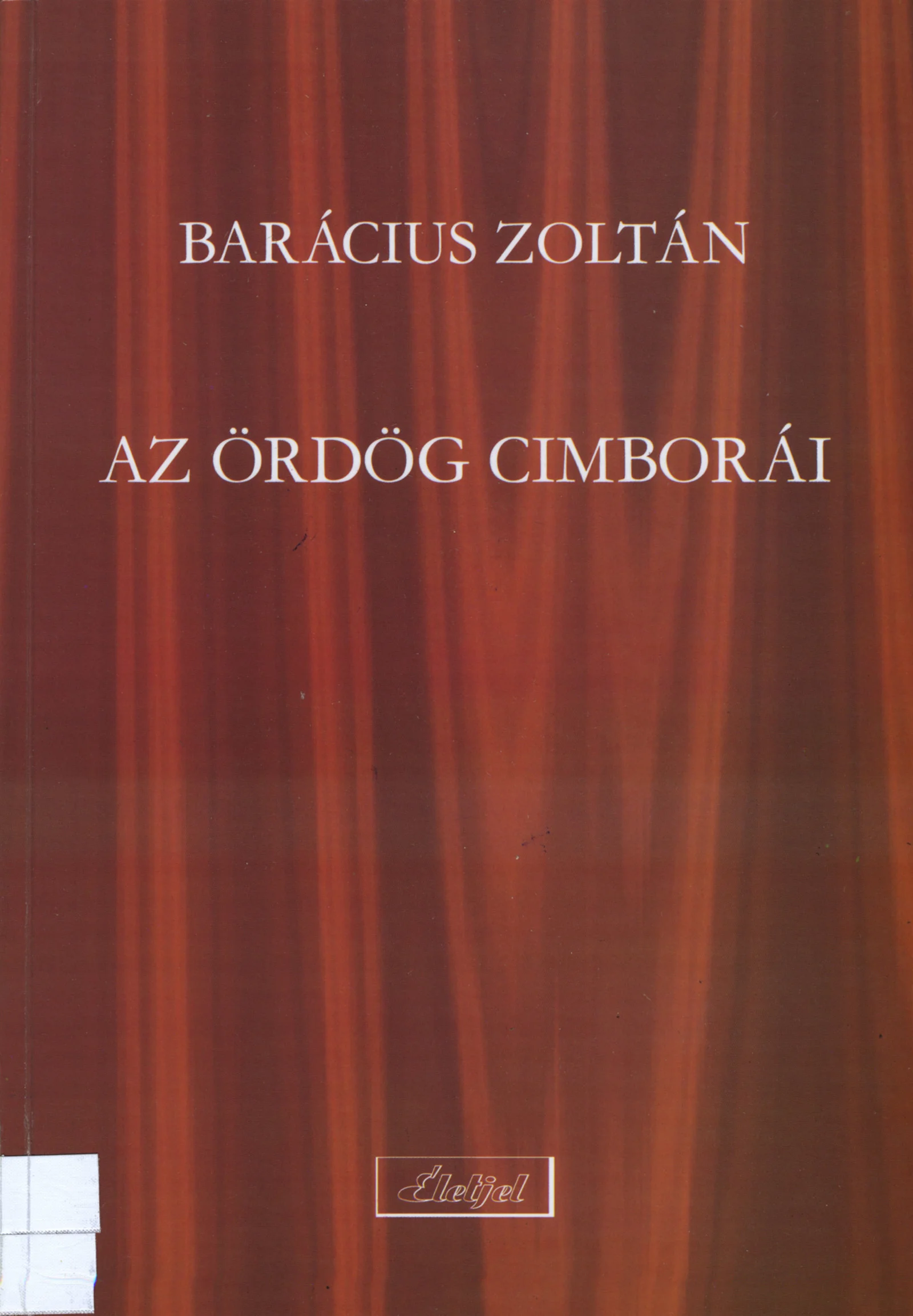
- Author:
- Barácius Zoltán
- Year and place of publication:
- 2005,Subotica
- Publisher:
- Szabadkai Szabadegyetem
- Responsible publisher:
- Perović, Blažo
- Series title:
- Életjel Könyvek
- ISBN:
- 86-82147-70-X
- Page count:
- 150 pages
- Genre:
- Monograph
- Subject terms:
- theater
Preface/Afterword
MADÁCH'S LAMP
FOREWORD
Between encounters and solitary contemplation, during the long train journeys of departures and homecomings, our theatrical past, sometimes melancholic, sometimes anecdotal, often resurfaced in my mind; faces appear before me, Ferenc Árok's terrified face after a night of revelry, faces disappear, Imre Dévics's face, as he whispered from his sickbed: "Zolikám, guard our theatre!" Everything fades away, like the sunflowers and stubble beyond the window. I agonize, I argue with myself, sometimes with bleary eyes at dawn, other times late into the night, and I would very much like someone to say with me, to shout into the world, that theatre, the Vojvodina Hungarian theatre, is not a matter of style, the success or failure of a performance, whether an actor's portrayal is good or bad, is not even worth mentioning, because the past, present, and future of our theatre is a national cause. Was it worth it, was it necessary for me to write, in the distant past, in 1992, after a shared holiday in Rovinj, the Mestermutatványok, the Mihály Virág breviary, and then four years later, the Megkésett rekviem, this "theatre lament" treatise, the recollection of the first and last Hungarian theatre in Nagybecskerek and Zombor, the Topolya company, to mention in bold letters – let our tears flow – that in the fifties, four (!) professional Hungarian companies could carry out their blessed mission in the province. After another six years, I wrote about Paula Heck, Zsuzsa Dürrigl Juhász, and the queen of actresses, Ibi Romhányi, sketching their careers under the title Néhány boldog óránk; in the volume Ötgarasos színház, I drew from the past of the Hungarian Company of the Subotica National Theatre, immortalizing the "golden age" with the literary tools of my modest talent. I evoked the images fading into the mist, I doffed my hat – not for the first time – to the work of Imre Dévics and our actors/directors, so that in this turbulent world, when not only friendships collapse, but dreams and beliefs turn to nothing, we can at least remember a little. Because – I venture to say: perhaps – we still possess the basic norms of moral values, we know, we want to know, that then (although statistics clamped our will in a vice, and under higher suggestion, we had to work with the compelling weight of political considerations) our faith and self-sacrifice, our great heart and great enthusiasm knew no impossibilities, we could perform superhuman work, and our predecessors – the amateurs, the Great Dilettantes – left a beautiful legacy for posterity and future generations. But can we today, in a public life burdened by confused time and situation awareness and inflamed by unprecedented national hatred, calmly line up names, numbers, data? All that we once proclaimed – I know – has become antiquated, even the voice of the Lord: "I told you, man: fight and trust with confidence..." "The Hungarian has a lamp, but no oil," said/wrote Imre Madách. And if the theatre does not light, does not kindle a small flame in the pitch-dark Vojvodina night, in which even owls no longer hoot, then what is the theatre for in the world? Well, I would like to believe that my latest volume – naturally on a theatrical theme – is also a small flame, which, even if it does not illuminate far, beyond the Óperencia, all the way to the new National Theatre, perhaps it illuminates as far as the corner pub, where everything that the past offered can already be considered null and void in an artistic and moral sense: the 14-15 performances per season of the Subotica National Theatre, Radoslav Dorić's production of Play Strindberg seen at the Novi Sad Theatre, the Topolya Hamlet, the Nagybecskerek Földindulás, the Zombor Olympia, the Tanyaszínház, whose company hides some secret every year, as if saying what Sándor Márai said: "The center of the universe is not Sirius, but the human heart, filled with God." Can we forget the Üvegfigurák seen on the Életjel Stage with the weeping audience and the actors wiping their tears before the curtain, the miniatures of the M Stúdió in Novi Sad, Mihály Virág's Caligula and Légszomj, the Áfonyák and the Koldusopera, István Szabó Jr.'s Antigoné? We must not forget the "years of shame" either, when in 1985 we entered the era of apostasy: cowardly, with compromise, serving a monster for a long time. However, let us also think about new beginnings! Then we rekindled Madách's lamp, although we did not have barrels of oil then, in the mid-nineties, and we don't have enough now either. But we protect, we guard the flame, lest someone blow it out, lest some people blow it out... That is why (even if /not/ with the thoroughness of a scholar, with adherence to the requirements of a scientific work) I wrote the previous volumes lined up on my shelves, and that is why I am now launching the fifth. I too hang the lamp above the table. And behold, there was light: this is what we were like, this is all our strength amounted to. At least as long as my lines are read, darkness flees, hopelessness flees, because for this we always had (whether we will, I don't know) the right to live and hope, not least to work, to toil – and to speak. Wajda also said: "Perhaps the theatre is the last place where one person listens to another's words!" Listen to my words. The account of how directors (primarily), who multiplied the adherents of love and passion, were able/wanted to create in eternal fever. Then – since I have lingered on the past – we created a spiritual and intellectual home, a warm home, and in that home we sometimes pruned each other, other times we nurtured and cared for each other. We would like to remember this now.
The Author
Table of Contents
- A MADÁCHI MÉCSES
- SZEGÉNY GAZDAGOK – GAZDAG SZEGÉNYEK
- GARDÉNIAILLATÚ SZÍNPAD
- Garay Béla15
- NYUGTALAN UTAZÓ
- Andrási Attila64
- SZELÍD TÜRELEMMEL
- Bambach Róbert70
- HOLDBÉLI CSÓNAKOS
- Hernyák György75
- TENGERNYI TUDÁSSAL
- Lányi István82
- HANGYASZORGALOMMAL
- Ifj. Szabó István90
- ÖRDÖGTÁNCOLTATÁS
- Urbán András97
- A RÖPÜLÉS ÖRÖMÉVEL
- Vajda Tibor102
- A LÉLEKIDOMÁR
- Varga István108
- A VAJDASÁGI SZÍNBÁD
- Vicsek Károly117
- A CSÖNDES SZABADKAI
- Virág Mihály122
- ŐFELSÉGE, A SZÍNÉSZ
- SZÍNÉSZEK, AKIK RENDEZTEK 1945-2005
- MEGHÍVOTT RENDEZŐK